Saturday, November 27, 2010

Guest Author Kathryn Beet: Evidence Based Yoga Nidra Heals what Ails You

(Lewis Carroll's sketch for Alice in Wonderland)
 "Let's pretend there's a way of getting through into it, somehow, Kitty. Let's pretend the glass has got all soft like gauze so that we can get through. Why it's turning into a sort of mist now, I declare...And certainly the glass was beginning to melt away, just like a bright, silvery mist".  (Through the Looking Glass, Lewis Carroll)

M ost days I forget any one of a number of things: my yoga card, my umbrella, or socks, at my home away from home, Yoga Space Toronto. Maybe that's just because of the sheer number of hours I spend at the studio. Or, maybe it has something to do with the slumbering ease I feel when I walk through those doors. You could call that feeling a kind of "nidra"; a diffuse awareness that day after day, my lost items will reveal themselves in some nook, some basket... and that the front desk will thoughtfully tuck my yoga card underneath their workspace yet again. I've come to trust that Yoga Space is all about making room for restful awareness; even if it means sometimes we're ambling around in a perforated, yoga-induced, dreamstate.

Founder and director Kathryn Beet began Yoga Space 15 years ago in a quiet alleyway on Bellwoods Ave in Toronto. Now expanded beyond its original space, the luminous hardwood floors on Ossington Ave are marked by a continuous, steady stream of staff and practitioners that have been with the studio for years. Kathryn is a sensitive, highly-intuitive and skilled teacher whose teaching style is a powerful blend of intelligent use of energy, and rigorous demand for the hard-facts; the evidence of the therapeutic benefits of asana. She prefers discussions that stay grounded in the physical realities of individual bodies, providing detailed verbal instruction, highly-effective hands-on augmentation, and definitive demonstration. She has been providing Yoga Therapy for individuals in clinical settings for 10 years. Gleaning insight from the many teachers, therapists and artists she has worked with over the years, she has created a unique fusion of yoga therapies in Therapeutic Yoga, which she has been cultivating at YogaSpace for 4 years. 

I had a rainy day chat with Kathryn Beet about her own practice; and discovered her growing interest in Yoga Nidra. I immediately asked if she would be willing to contribute her ideas as a guest author. In the following post, Kathryn explores the mounting scientific evidence in support of the long tradition of Yoga Nidra, its therapeutic benefits, and its transformative potential.
~ ~ ~

Evidence Based Yoga Nidra Heals what Ails You
by Kathryn Beet
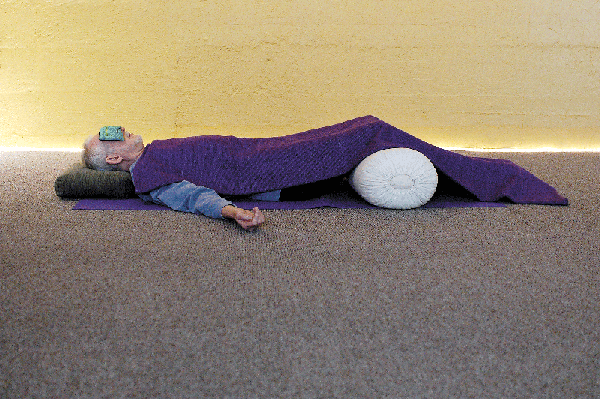
(Photo of Savasana, Corpse Pose, covered in a blanket)


Y oga Nidra, which means sleep of the Yogi, is an ancient, sacred yogic practice of meditation that can lead to profound changes in both mind and body.  It is a vital resource for transforming physical health and reshaping personal, interpersonal and professional relationships.  The origins of Yoga Nidra can be traced back to the ancient sacred teachings of Yoga and Tantra.  The practice has been revived over the last half century by Yogis, such as Swami Satchidananda and Nischala Joy Devi, to name a few.  Most recently, clinical psychologist Richard Miller has effectively demonstrated the indubitable healing potential of Yoga Nidra to mainstream North America.

Founder of the Integrative Restoration Institute in California, creator of iRest Yoga Nidra and author of Yoga Nidra, A Meditative Practice for Deep Relaxation and Healing, Miller serves as a research consultant, researching the healing effects of Yoga Nidra on diverse populations including soldiers, veterans, college students, children, seniors, the homeless and people suffering from depression, anxiety, chronic pain, insomnia, chemical dependancy and Post Traumatic Stress Disorder, (PTSD).

In 2006, the United States Department of Defense conducted research on the iRest Yoga Nidra protocol with soldiers returning from Iraq and Afghanistan experiencing PTSD.  Following the study, the Deployment Health Center integrated Yoga Nidra into it's weekly treatment program for soldiers. Yoga Nidra classes have subsequently been set up in treatment facilities throughout the U.S.

Saturday, November 20, 2010

Queen Street Yoga Turns Five in Good Health and High Spirits: An Interview with Founder and Director Meaghan Johnson

  "For some reason, I went and looked at it, and the space was just huge, with hardwood floors and high ceilings, and there two rooms like that with change rooms. And I just thought, "Oh crap, we have to start a yoga studio"!
 
(Meaghan Johnson, Founder and Director, Queen Street Yoga, Kitchener, Ontario)


Q ueen Street Yoga recently celebrated its fifth birthday in its birthplace, Kitchener, Ontario. That's no small accomplishment for a small studio that opened during a yoga boom. But, with an expanding array of classes and workshops in yoga and meditation, and a focus on the therapeutic function of yoga as pertains to stress, trauma and illness, Queen Street Yoga has managed not only to survive, but to grow its reach and impact in local communities.  Part of this buoyant, "can-do" atmosphere owes itself to the high-spirited approach of Queen Street Yoga's founder and director, Meaghan Johnson, whose exuberance and engagement with her own practice is palpable in our interview.

Meaghan Johnson was first introduced to Yoga in 1992, and has had a dedicated practice for the last 8 years. She began teaching yoga in 2002 after completing a 250 hour teacher training in Toronto. She completed a second teacher training with Hart Lazer in 2004 and has been studying with him ever since. She is influenced and supported by the yoga teachings of Ramanand Patel and Donna Farhi. Meaghan also maintains a regular meditation practice, and completed a month long silent retreat in the Tibetan tradition in India. A self-proclaimed arts enthusiast, she's actively involved in running Queen Street's operations, as well as overseeing its increasing reach in several communities. In our interview, Meaghan talks about her own encounter with yoga in her early teens, and its mitigating influence on her later struggles with bi-polar disorder. We also chat about what it's like to run a yoga studio in a city that sits in the quieter shadows of the big-smoke, Toronto; and, her interest in taking yoga into art galleries to explore the relationship between therapeutic body practices and art.
~

(Meaghan Johnson, Queen Street Yoga)


"Often there's a lot of rhetoric in yoga and meditation that doing these things is going be blissful and relaxing. And for many people, that's really not the experience they encounter. You're actually going to be thrown back into this body that remembers everything that happened to you."     (Meaghan Johnson, Queen Street Yoga)


Interview with Meghan Johnson of Queen Street Yoga, Kitchener, Ontario: 

PT: What was the actual anniversary date for QSY? 

Meaghan Johnson: I'm not really sure actually. It's funny i'm just not very nostalgic that way, but I think it was at the beginning of September 5 years ago...So our actual birthday is over - but we consider it a long birthday. In some ways it's been an amazing five years. I often say, you know the community must want this yoga studio because I'm just flying by the seat of my pants trying to keep up (laughs)

Friday, November 12, 2010

Syrinx and Systole, Guest Author Matthew Remski Introduces his New Book of Poetry

(Syrinx 2, Marion Dunleavy)
"She will recede with each increment of
light, with each syllable you find in your throat like a cave
painting. The reverberation in the bark is the stutter of your
hand letting her go.
The choir of earth. Over the reeds, the long exhale of don’t
know anything. The shiver that cracks the spine as more
apples blossom, turn red, turn cider, turn vinegar, turn ash." 
(from Syrinx and Systole, Matthew Remski)

M ost of you know Matthew Remski as co-director of Yoga Festival Toronto, an Ayurvedic Health Educator and Practitioner, and adjunct faculty member for many Yoga Teacher Training Programmes in Toronto. Many people are also familiar with the Matthew Remski, who, along with fellow yogi and author, Scott Petrie, co-authored the wildly imaginative and iconoclastic text on re-embodying yoga, entitled Yoga 2.0. But perhaps you are not aware that he has also published several novels, and founded Scream in High Park, a literary festival that has since grown into the 2-week-long crowning event of alternative Canadian literature. Now, on the heels of unleashing Yoga 2.0, Matthew will be releasing his first book of poetry in fifteen years. A book launch will be held at the Supermarket (in Toronto's Kensington Market) on Tuesday, November 16 · 7:00pm - 9:00pm. 

I asked Matthew if he would like to contribute a piece of writing about the launch of his new book, and he responded,
 "Sure. should it be manifesto-style?"
 And Matthew, oracular and enigmatic, offered us this arrangement of words.
~
(The Unknown Potter, Arthur Boyd)

on launching syrinx
by matthew remski

the pages are lined with consciousness and birdsong, orality and aurality, the oscillation of separateness and communion, space and its filling, the dissociation of seeking, the pervasion of being found, loving the identity-trauma of learning.  learning as terrible pleasure, learning as food.  learning is food, so we are fed by what we have yet to know.

content is paramount: form serves it like a dish serves food.  sleep washes the dishes.

the structure of this book saddens.  not because of its sentiment, which chirrs and clicks between the oriole and the occipital.  not because it is this book, as opposed to any other, it is sad because as a collection of meditations it does not like the prison of a book generally.  it cannot understand the mathematics of a print run, why its words cannot change.  it flutters confused and now resigned against the papers, against the spine.

Thursday, November 4, 2010

When Discipline Sets You Free, The Beauty of a Dogmatic Practice: David Robson on Mysore-style Ashtanga Yoga


(David Robson, right. with pilgrims at Sravanabelagola)
"The beauty of the practice is that, inside of the structure of it, there is still room for interpretation." (David Robson, Co-Owner and Director of Ashtanga Yoga Centre of Toronto)

(David Robson, photo by Cylla von Tiedemann)
T o be honest, it makes little sense to hear David Robson, co-owner and director of the Ashtanga Yoga Centre of Toronto, talk about struggling with focus. He wakes up at 3am each morning in order to do a few hours of asana practice before he heads out for his teaching day which begins at 6am. But then, it's often the people who have a measure of focus that know how disconcerting it is to work without it.

After completing a degree in Comparative Religion, David Robson made his first trip to Mysore in 2002, where he initiated studies with his teacher Sharath Rangaswamy. Since then he has returned annually to deepen and enrich his practice and teaching. In 2008 David was Authorized to teach Ashtanga by the Sri K. Pattabhi Jois Ashtanga Yoga Institute of Mysore, India.

I first saw David Robson speak at Yoga Festival Toronto, in a workshop he provocatively titled, Dogma and Discipline. In our hour-and-a-half workshop, David put about thirty practitioners through their paces, slowly and deliberately teaching a sun salutation, followed by standing poses from Ashtanga's first series. Words like regulation, prescription, numerical breathing, dharana, and drsti filled the air; sibilant, measured and consistent as the clock's tick on the back wall of the studio. Each pose was meticulously explained, adjustments were made, we were instructed to find stillness in each pose, and to submit to the discipline that each posture promises.  Furthermore, each student was clear by the end of the class that there were to be no extraneous gestures; no cycling of feet in downward dog, no flicking back of hair strands, and no readustments of spandex, in the repetition of this traditional sequence.

But, as is obvious in our interview, you would be making a mistake if you assumed David Robson was a dogmatic personality, or a rigid teacher that measures out generic prescriptions from the topsoil of his yogic life. Instead, David's approach is the result of years of mining his own search for realization. As David says, "the body is your laboratory"; and, he's taken a look at the substrata of his own makeup, and its fairshare of competing and contradictory inclinations.

In our interview, we have the privilege of observing David's map of complex choices, as he searched for something, "a spiritual high", he couldn't quite name. From his first self-taught encounter with yoga from a nameless book of poses, to playing in an improv post-rock band with Peaches, to travelling the world seeking out his version of Maslow-inspired "peak experiences",  and teaching Bikram Yoga, Robson's early experiences with yoga are energetic and restless. Not until he met Sri K. Pattabhi Jois and his grandson, Sharath Rangaswamy, did Robson feel he had found a powerful diagram for transformation: Mysore-style Ashtanga yoga.


(David Robson at Yoga Festival Toronto, 2010)
 "I was pretty irreverent in my approach to yoga initially. But, you know in some ways, the seriousness with which you approach it, seems to be proportionate with the change that it can effect".  
             (David Robson, Co-owner and Director of the Ashtanga Yoga Centre of Toronto)

~

Dogma and Discipine, Interview with David Robson of Ashtanga Yoga Centre of Toronto:

 Priya Thomas: Hi, is that David?

David Robson: Hi Priya, how are you?

Priya: good thanks, thank you for doing this...So when did you start practicing yoga?

David Robson: I started doing asana classes about twelve years ago. I started with Sivananda style. A friend of mine knew I liked yoga; I had been doing it out of books and things like that..but very infrequently. And so she brought me to a class. And I had no idea actually that were yoga classes.

Priya: Really??

David: Yeah (laughing)

Priya: So where did you find books from?

David:  You know I can't even remember the books that I had. I had books with different pranayamas, and things like that; and simple asanas. But I didn't know that people were in rooms doing it together! I thought it was just something you always did alone.

Priya: oh wow.

David: Yeah I had no idea. I guess I was just out of it! (laughing). So anyway, this friend brought me to a Sivananda class in Toronto; the one at Spadina and Harbord. And I was amazed that all these people were in a room together doing it! And there was a teacher walking around; and it was so relaxing. I immediately fell in love. And at the time, I had just come back from a long trip away, and I had just started studying religion and U of T. So the week after that, I went back twice; and then before I knew it, almost right away, I was going every day.

Tuesday, October 26, 2010

Great Times are Waiting, Shivers up the Spine 5 Days in NYC: Leslie Kaminoff, Tom Myers, Robert Mahon and IDP

I opened the window from my hotel room to a warm chinook blowing in to Manhattan's lower east side. Thank god the window actually opens, I thought. I could see the alley below, announcing a small market, and folks were in and out of the passageway all day long. I had planned to get a good amount of writing done; but there was no internet access at the hotel...or at least not an internet that could stay connected consistently. The front desk looked at me quizzically when I mentioned it; but I knew from his blank, rapid blinking, he was well aware of the problem.

One small room, with a window, and a squirrel that was eating the floorboards underneath me...a shared bathroom down the hall, and walls paper thin so that I could hear the writer rooming next to me talking about her next screenwriting project. It wasn't much; but it was New York City, and I was within spitting distance of everything I needed. So, apart from seeing bands at CMJ, I was going to make it my business to get out and do as much yoga as possible.


This is my recap of Yoga NYC; but it also gives you a bit of a taste of what's upcoming on Shivers Up the Spine heading into the cold season.

O n Thursday afternoon I met with Robert Mahon, whose photographs had formed the basis for the post, "Into the Slipstream; The Yoga of Chance in the Photography of Robert Mahon". We had lunch and chocolate in Chelsea; paid quick homage to the Chelsea hotel; spent hours lounging on the lawn chairs of the Episcopal Seminary Gardens in the warm sunlight of autumn. We never made it to MOMA; but for any of you out there curious about seeing more of Robert's work in the flesh, you can go to the AKA hotel Times Square; and on every single floor is one of a series of stunning photographs of New York City's most recognizable landmarks entitled, "The Liberty Series". Of these, the photos of Lady Liberty remain with me; her form under tender veils of reconstruction scaffolding, a vaulting iceberg in repair over black sheets of water. The images are striking enough to make you want to ride the elevator up and down all day. This is an excerpt from the Hotel's guide to the series:
AKA Times Square is pleased to present Liberty Series, a selection of 12 photographs by Robert Mahon, on display in the hallways facing the elevators and in the fitness center.  Printed in 2010 by the artist especially for AKA, the original photographs of the Statue of Liberty, World Trade Center, Ellis Island, and the New York Harbor were taken by the artist in 1983 and 1984.  Many of these archetypal images having the theme of arrival and departure are aerial photos taken from a helicopter flying close to the Statue of Liberty.

Sunday, October 24, 2010

There is No Such Thing as a Dead End: Two Burmese Monks Describe the Saffron Revolution

(U Pyinya Zawta, All Burma Monks Alliance)
"hatred is never appeased by hatred...only lovingkindness"
(U Pyinya Zawta, Burma, Buddhism and Non Violent Revolt, University of Toronto, Oct 18, 2010)

What makes a movement move? This is a question that has been with me ever since I attended the talk Buddism, Burma and Non-Violent Revolt at University of Toronto last week. I mean, it's an oddity that movements happen at all; since most of them begin with a dedication to the impossible, the implausible, and sometimes, what many would call, "the lost cause".

There was a hum of fluorescents that ran through the room on the 7th floor of University of Toronto's Oise building last Monday. The "Peace Lounge" sounded bright, animated by shuffling of feet, paper handouts, and pamphlets rustling...microphones humming, clipping, and then petering out. Across to my right were two batik room dividers, and then a row of volunteers flanked by tables of books and petition papers. As people took their seats, the cyclopic eye of a camera turned to a tall figure standing in front of a wall of windows.

 "Hello, it's good to see so many of you out".

Michael Stone delivered a warm welcome to the attentive group of 100 or so gathered in support of the event. Co-presented by Centre of Gravity Sangha, Amnesty International and Shambhala Toronto, the evening featured two Burmese monks, U Pyinya Zawta and U Agga Nyana who were invited to tell their stories about their experience in the Saffron Revolution of 2007. In addition to detailing the events associated the uprising, the event was intended to expose the continued plight of Buddhist monks amidst the sustained brutality of the military regime in Burma, as well as the difficulties faced by monks who have relocated to North America.

Thanking those assembled, Michael talked about the importance of getting real people and communities involved. He cited Malcolm Gladwell's recent article in the New Yorker entitled, "Small Change: the Revolution will not be Tweeted", in order to illustrate a growing sense of the shortcomings of social networks as pertains to disciplined, social engagement.  With a nod to Bernie Glassman and the First Symposium of Engaged Buddhism this past summer, he also cited the importance of the evening's talk as part of a larger dialogue on Buddhism as social action on North American soil; and reminded people that getting movements to "move" really depends on interdependence. On the heels of this brief introduction, Myanmar Coordinator for Amnesty International, Brian John, articulated a synopsis of the political context in Burma, and outlined Amnesty's determination to increase public awareness of the current military regime's long list of human rights violations.


These very human rights violations were detailed through the first-person narrative of two Burmese monks, as all eyes turned to  to U Pinya Zawta and U Agga Nyana. Both spoke of imprisonment and torture at the hands of the military regime with a curious combination of softspoken intelligence and straight-talk. In a particularly moving moment, U Agga Nyana described the lasting influence of Aung San Suu Kyi, Burma's opposition politician, who is still living under house arrest, in saying:

"She is still in our hearts".

Monday, October 11, 2010

Transnational Yoga Part 1: An Interview with Blogger Roseanne Harvey of "It's all Yoga Baby"


The community portals have been hacked. Advertisers have your home number; and now they're calling at dinnertime. Yoga blogs, once the independent voice of an online community, are now the locus of increased corporate sensibility; your discussions will be interrupted for "these special messages from our sponsors".  In this 3-part series on Transnational Yoga,  I interview 3 writers with regard to their own research on yoga and commodity, the practices that comprise contemporary yoga, and the origins of our asana-heavy, posturific, yoga culture.


I went into this interview assuming I would write a piece about what it means to be a blogger; a critical, independent voice in the yoga community, armed with the wit and candour to observe the fascinating negotiations that are happening between yoga and capitalism the world over. After all, my interview had been scheduled for over a month, and it was with the fabulous blogger, Roseanne Harvey, of It's All Yoga Baby.

Kamloops-raised, Roseanne Harvey came to yoga at University, originally as an attempt to manage the stress of a busy workload. Over time, however, the practice took root; and Harvey found herself settling in at Yasodhara Ashram, B.C, upon the advice of close friends. By the end of her stay, Harvey had found a deepened passion for yoga, and a new community newsletter to write for the ashram. Eventually, Ascent Magazine, an independent, not-for-profit publication dedicated to spirituality and yoga, was born through Yasodhara; and Roseanne Harvey was at the helm of its editorial functions. The publication ran from 1999 through 2009; and, when the much-loved magazine closed it doors, Harvey turned her attention to blogging.

In our interview, Harvey talks about the importance of resisting corporate interest, and how she hopes to serve as an example of an independent, anti-commercial voice for the yoga community; and, how yoga partnerships with corporations that propogate an idealized vision of the female body are problematic. Yet, by the time I reached her, late last week, Roseanne Harvey had signed a deal with Wonderbra for her blog. Furthermore, in our conversation, she details the contractual restrictions on her blogging voice inherent in this relationship.


Blogging for Yoga, Interview with Roseanne Harvey:

"I realized that I resist the commercialization of yoga because I resist the commercialization of everything. I don’t believe that yoga deserves special treatment; I believe that the commercialization of everything, from food to sex to art, is unhealthy for people and our world."
("WSJ Stefanie Syman on how Yoga Sold Out", from It's all Yoga Baby, by Roseanne Harvey) 

 PT: So Roseanne, you started a blog, would be a year and a half ago now?

Roseanne Harvey: Yeah I started the blog after the magazine closed. While I was at the magazine I was responsible for the magazine's blog, along with so many other things with editing etc. So it was always a pain in the butt. I always hated doing it. I had to handle that as well as so many other things. But then once when the magazine closed it was much easier as an independent person, to publish a blog, than to publish a magazine. So I just needed a space where i could continue to explore yoga and maintain the connections that I made while i was at the magazine; and, do it in a place where it was on my own terms, where i wasn't representing anyone else's interests.

PT: Do you find that a lot of yoga conversations, whether they happen through blogs, books or magazines, have been co-opted by something, or somebody else's interests?

Roseanne Harvey:  I find that in the blogging community it's not co-opted. There's a very independent spirit within the blogging community; and most people who blog do it for themselves. Most of them are yoga teachers or just yoga practitioners so they're not representing any other system or whatever. And in terms of being co-opted, I mean yeah, there's no kind of formalized system to really co-opt these voices, other than blogs like the Yoga Journal blogs and some others...If a writer/blogger is really ambitious and wants to contribute to the Huffington Post, then, sure it's been co-opted. But generally, I find there's a lot of independent voices.

PT: What would you say the difference is between writing for the the Yoga Journal blogs, or Huffington Post, and being an independent blogger?

Roseanne Harvey: Yeah, it's hard to say, because I haven't had the experience of writing for Yoga Journal etc; but I think that there's a different mandate. And Yoga Journal has several high profile teachers that are currently blogging for them and yeah, most of the writing I see is not critical and analytical or whatever. It tends to be experiential and anecdotal. 

(photo by erin vosti lal)

PT: Ok. I guess that leads into my question about magazine culture re. yoga in North America. What do you think of the kind of yoga advertising we're seeing in magazines? Where is it all going?

Roseanne Harvey:  Uh hmm... Yeah, well i think that a communication vehicle is good for the yoga community. I think that it's good to provide accessible information for people who are simply curious. And all magazines are fuelled by advertising because that's how the industry works.  In terms of yoga magazines I think that they're an essential part of the evolution of yoga in North America. If we look at yoga magazines now, there are only two I can think of in print right now; Yoga Journal and Yoga International, and then a handful of other spirituality magazines. But what I see there is not a lot of diversity, a big emphasis on the physical aspects of the practice, a certain kind of representation that's soft-focus, fuzzy, women-in-spandex, lotus flowers and candles.. this very idealized image of spiritual practice...which doesn't always represent the whole story of the practice.